BACKGROUND OF FOREIGN TRADE POLICY
Introduction
The Ministry of Commerce and Industry is authorised to formulate and announce policies for governance and development of exports and imports and the overall regulation of foreign trade. The Foreign Trade Policy 2015-2020 (hereinafter referred to as “FTP 2015-2020”) was announced on 1st April 2015 under the provisions of the Foreign Trade (Development & Regulation) Act, 1992. The FTP subsequent to the mid-term review underwent few revisions which were implemented from 5th December 2017. The Directorate General of Foreign Trade (DGFT) is the controlling and supervising authority for various provisions of FTP.
Objectives
The foreword to FTP 2015-20 lays down its broad adjectives which primarily
include:
- Providing a framework for increasing exports of goods and services;
- Generation of employment;
- Increasing value addition in the country;
- Supporting both manufacturing and services sector;
- Improving ease of doing business.
Incentives under FTP
FTP 2015-2020 introduced two new incentive schemes, namely Merchandise Exports from India Scheme (MEIS) and Services Exports from India Scheme (SEIS) with a view to replace multiple schemes which all had different conditions for eligibility and usage. Other incentive schemes such as Export Promotion Capital Goods (EPCG) scheme and Advance Authorization scheme have been continued under FTP 2015-20.
EXPORTS FROM INDIA SCHEMES
FTP 2015-2020 contains two schemes under exports from India, namely,
- Merchandise Exports from India Scheme (MEIS)
- Service Exports from India Scheme (SEIS)
Nature of rewards
Under both MEIS and SEIS, the rewards are in the form of duty credit scrips. These duty credit scrips as well as the goods imported/exported procured against such duty credit scrips are freely transferrable.
The duty credit scrips can be used for the following:
- Payment of Basic Customs Duty (BCD) and Additional Customs Duty (ACD) for import of inputs or goods, including capital goods (including BCD and ACD payable in case of default in export obligations);
- Payment of Central excise duties on domestic procurement of inputs or goods;
Practically, with the implementation of GST, usage of scrips for payment of ACD and central excise duty have lost relevance. Further, the duty credit scrips cannot be used for payment of IGST and GST compensation cess, if applicable.
The duty credit scrips are valid for a period of 24 months from the date of issue. The holder of duty credit scrips is allowed to sell such scrips
in accordance with the procedure laid down in FTP 2015-20, thereby facilitating immediate monetisation.
The duty credit scrips are granted at the notified percentage of FOB value/Net Foreign Exchange (NFE) earnings earned by eligible exporters in case of MEIS/SEIS respectively. The rate of rewards can range from 2% to 7%.
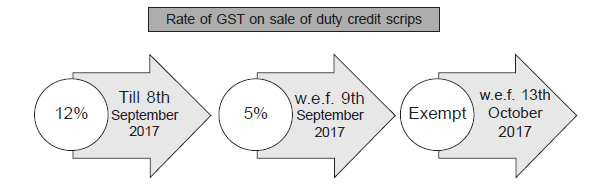
Earlier, GST at the rate of 12% was applicable on sale of duty credit scrips. This rate was reduced to 5% with effect from 9th September 2017. However, vide Notification No. 35/2017-Central Tax (Rate) dated
13th October 2017, the sale of duty credit scrips has been exempted from GST.
Late cuts
Any delayed application for any financial benefit under FTP 2015-20 may be considered after imposing a
late cut i.e. a deduction from the eligible reward, as under:
|
Delay of |
Late cut |
|
Up to 6 months |
2% |
|
More than 6 months but up to a year |
5% |
|
More than a year but up to 2 years |
10% |
Merchandise Exports from India Scheme
The objective of Merchandise Exports from India Scheme (MEIS) is to offset infrastructural inefficiencies and associated costs involved in export of goods, which are manufactured in India. The focus of MEIS is on goods having high export intensity, employment potential which can thereby result in enhancing India’s export competitiveness.
The list of goods on the export of which incentives under MEIS can be claimed is contained in Appendix 3B to FTP 2015-20.
The said appendix also provides the rate of rewards applicable on each eligible product. The rate of reward under MEIS ranges from 2% to 7%.
The rewards under MEIS should be calculated on the basis of:
|
Realised FOB value of the exports in free foreign exchange; or |
|
|
FOB value of exports as given in the shipping bill in free foreign exchange |
whichever is lower.
The following exports are ineligible for duty credit scrips entitlement under
MEIS:
- Supplies made from DTA units to SEZ units;
- Export of imported goods covered under paragraph 2.46 of FTP 2015-20;
- Exports through trans-shipment, meaning thereby exports that are originating in third country but trans-shipped through India;
- Deemed Exports;
- SEZ/EOU/EHTP/BTP/FTWZ products exported through DTA units;
- Export products which are subject to Minimum export price or export duty;
- Exports made by units in FTWZ.
MEIS application has to be filed on or before:
- 12 months from the Let Export (LEO) date, or
- Three months from the date of
- Uploading of Electronic Data Interchange (EDI) shipping bills onto the DGFT server by Customs
- Printing/release of shipping bills for non-EDI shipping bills.
whichever is later, in respect of shipments for which claim is being filed.
- The application for claiming rewards is to be filed online, using digital signature, in Form ANF 3A.
- For export of goods through courier or foreign post office using e-commerce, application has to be filed in Form ANF 3D.
- In case of EDI shipping bills, a single application can be filed containing shipping bills of different EDI ports.
- One application under MEIS can contain a maximum of 50 shipping bills.
Service Exports from India Scheme
The objective of Service Exports from India Scheme (SEIS) is to encourage and maximize export of notified services from India.
- The list of notified services and their respective rate of rewards is contained in Appendix 3D to FTP 2015-20. The rate of reward under SEIS ranges from 2% to 7%.
- Service providers of notified services, located in India are eligible under SEIS. It is pertinent to note that software and information technology enabled services, which form a major part of India’s services export, are not covered under SEIS.
- The eligible categories for availing SEIS are as follows:
- Mode 1 - Cross border trade
Supply of a service from India to any other country
- Mode 2 - Consumption abroad
Supply of service from India to service consumers of any other country in India
- Eligible service providers should have minimum NFE earnings in the year of
rendering service as follows:
|
Service provider |
Minimum NFE earnings in USD |
|
Individual and sole proprietor |
10,000 |
|
Others |
15,000 |
- The service provider should have active Importer-Exporter Code (IEC) at the time of rendering such services for which rewards are claimed.
- The SEIS application should be filed within 12 months from the end of the relevant financial year.
- The service provider should hold:
- IEC
- DGFT digital signature
- Registration-Cum-Membership Certificate (RCMC)
- CA certification
- SEIS application should be filed online.
- Prescribed documents should be submitted manually.
- In case of ambiguity in estimating the eligibility of services qualifying under Appendix 3D, reference must be made to Services Sectoral Classification List prescribed by the WTO which is aligned to Central Product Classification (‘CPC’) code.
EXPORT PROMOTION CAPITAL GOODS SCHEME
Objective
The objective of Export Promotion Capital Goods (EPCG) scheme is to facilitate import of capital goods for producing quality goods and services to enhance India’s export competitiveness.
Incentives
The EPCG scheme allows import of capital goods for pre-production, production and post-production at zero Customs duty. In certain cases, procurement of capital goods from indigenous sources is also allowed.
Coverage
- EPCG scheme covers manufacturer exporters with or without supporting manufacturers, merchant exporters tied to supporting manufacturers and service providers.
- The scheme also covers a service provider who is designated/certified as a Common Service Provider (CSP) by the DGFT, Department of Commerce or State Industrial Infrastructural Corporation in a Town of Export Excellence subject to provisions of Foreign Trade Policy/Handbook of Procedures, subject to certain conditions.
Export obligation
The imports under EPCG scheme is subject to an export obligation (EO)
equivalent to 6 times of duty saved on capital goods. This EO should be
fulfilled within 6 years from the date of issue of authorization under EPCG
scheme. Following key conditions should apply for fulfilment of EO:
- EO should be fulfilled by the authorisation holder through export of goods which are manufactured by him or his supporting manufacturer/services rendered by him, for which the EPCG authorisation has been granted.
- In case of indigenous sourcing of capital goods, specific EO would be 25% less than the normal EO stipulated.
- Shipments under Advance Authorisation, DFIA, Drawback scheme or reward schemes under Chapter 3 of FTP would also count for fulfilment of EO under EPCG scheme.
- Export shall be physical export. However, certain deemed exports are also counted towards fulfilment of EO.
- Royalty payments received by the authorisation holder in freely convertible currency and foreign exchange received for R&D services would also be counted for discharge under EPCG.
- Payment received in rupee terms for such services as notified in Appendix 3E of FTP 2015-2020 would also be counted towards discharge of EO under the EPCG scheme.
Key procedural aspects
- Application, along with the prescribed documentation, has to be filed by the registered office or a branch office or manufacturing unit of an eligible exporter with the Regional Authority (RA) in Form ANF 5A.
- A nexus certificate from an Independent Chartered Engineer should also be submitted. Any anticipated reasonable wastage at the time of installation of capital goods should also be certified in the nexus certificate.
- Within 6 months from the date of completion of import, the authorisation holder should furnish a certificate to the RA, confirming the installation of capital goods. Such certificate should be obtained from the jurisdictional Customs authority or an independent Chartered Engineer, at the option of the authorisation holder.
- Before clearance of goods through Customs, authorisation holder shall execute a bank guarantee/Letter of Undertaking with Customs Authorities.
Closure of authorisation licence
The closure of authorisation license under EPCG scheme will be as follows:
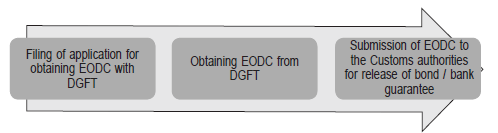
- Obtaining Export Obligation Discharge Certificate (EODC) in case of fulfilment of EO.
On fulfilment of EO under EPCG or advance authorisation, as the case may be, the authorization holder should obtain EODC from DGFT and submit the same with Customs authorities for release of any bond/bank guarantee submitted.
- Surrender of authorization licenc
 e in case of inability to fulfil the EO. e in case of inability to fulfil the EO.
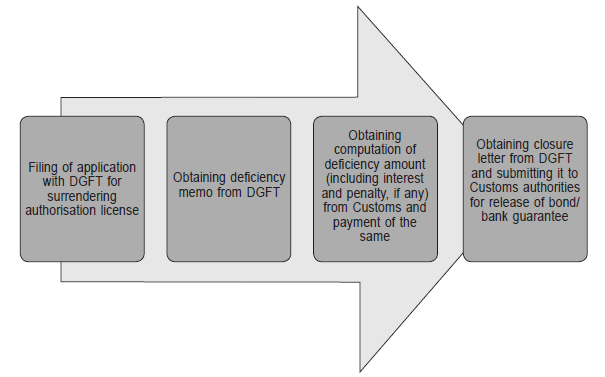
In a scenario where an authorisation holder is unable to fulfil the EO, the
applicant should apply for surrender of licence by paying the amount of
applicable duty, along with the applicable interest and penalty, if any. The
procedure in this regard is as under:
ADVANCE AUTHORISATION
Introduction
Advance authorisation is issued to allow duty free import of input, which is physically incorporated in an export product. A normal wastage allowance is provided for. Further, an allowance may also be made for fuel, oil, catalyst which is consumed/utilised in the process of production of export product.
Benefits available
Imports under advance authorisation are exempted from payment of the
following:
- Basic Customs Duty;
- Additional Customs Duty, Education Cess, Anti-dumping Duty, Countervailing Duty, Safeguard Duty, Transition Product Specific Safeguard Duty, wherever applicable;
- Imports against supplies covered under para 7.02 (c), (d) and (g) of FTP 2015-2020 will not be exempted from payment of anti-dumping duty, countervailing duty, safeguard duty and transition product specific safeguard duty, if any;
- Imports under advance authorisation for physical exports are exempt from whole of integrated tax and compensation cess leviable under sub-section (7) and (9) respectively, of section 3 of Customs Tariff Act, 1975. This exemption is valid till 1st October 2018.
Advance authorization is issued for inputs in relation to the resultant
product, on the following basis:
- Notified Standard Input Output Norms (SION)
- Self-declaration by the applicant in accordance with para 4.07 of Handbook of Procedures of FTP 2015-2020.
- Applicant specific prior fixation of norms by the Norms Committee.
- Self-ratification scheme in accordance with para 4.07A of FTP 2015-2020.
Eligibility
The following are the eligible categories for obtaining advance
authorization:
- Manufacturer exporter or merchant exporter tied to a supporting manufacturer;
- Pharmaceutical products manufactured through non-infringing process (in accordance with para 4.18 of Handbook of Procedures of FTP 2015-2020) - only for manufacturer exporter;
- Physical exports, including exports to SEZ;
- Intermediate supply;
- Supply of goods to categories mentioned in paragraph 7.02 (b), (c), (e), (f), (g) and (h) of FTP 2015-2020.
- Supply of ‘stores’ on board a foreign going vessel/aircraft, subject to condition that there is specific Standard Input Output Norms in respect of item supplied.
Actual user conditions for advance authorisation
- Before clearance of goods through Customs, authorisation holder shall execute a bank guarantee/Letter of Undertaking with Customs Authorities.
- Material imported under advance authorization should not be transferred even after completion of export obligation.
- In case where input tax credit facility on inputs has been availed for exported goods, even after completion of export obligation, the goods imported against such Advance Authorisation should be utilized only in the manufacture of dutiable goods whether within the same factory or outside (by a supporting manufacturer).
- Waste/scrap arising out of manufacturing process, as allowable, can be disposed off on payment of applicable duty even before fulfilment of export obligation.
- Under Advance Authorisation, a minimum value addition (VA) of 15% is required.
VA = (A-B)/B * 100
where,
A = FOB value of export realized/FOR value of supply received;
B = CIF value of inputs covered under the Advance Authorisation and value of any other inputs on which benefit of drawback is claimed or intended to be claimed
Closure of authorisation license
The procedure for closure of advance authorisation license is similar to closure of EPCG licence.
EXPORT ORIENTED UNIT SCHEME
Introduction
Units setup to export their entire production of goods and services (except permissible sale in DTA) maybe set up under the Export Oriented Unit (EOU) Scheme. Trading units are not covered under these schemes. Objectives of this scheme is to promote exports, enhance foreign exchange earnings, attract investment for export production and employment generation.
Key aspects of EOU Scheme
- Initially under the GST regime, upfront duty exemption available on procurement of imported goods by EOU prior to GST regime was restricted to Basic Custom Duties (BCD) till 12th October 2017. With effect from 13th October 2017, this exemption was also extended to Integrated GST and Compensation Cess till 31 March 2018. Subsequently, upfront exemption from BCD, IGST and Compensation Cess has been extended till 2nd October 2018 vide Notification No. 33/2018-Customs dated 23rd March 2018.
- Erstwhile procedure of availment of upfront duty exemption on imported goods through Procurement Certificate (PC) has been discontinued. Under GST, upfront exemption can be availed by 100% EOUs by following the procedure prescribed under Rule 5 of the Customs (Import of Goods at Concessional Rate of Duty) Rules, 2017.
- Erstwhile procedures of availment of upfront duty exemption on indigenous goods through CT-3 Certificate has been discontinued. Under GST, upfront exemption on indigenous procurement from DTA can be availed by 100% EOUs by following the procedures as prescribed under Notification No. 14/14/2017-GST dated
6th November, 2017. Such supplies to EOU will be considered as Deemed Exports, and accordingly, DTA supplier or EOU can claim refund of tax paid on such supplies.
- Administrative Control over EOUs located in non-port cities has been restored back to the Jurisdictional Custom Offices in place of jurisdictional Commissioner of Central Excise under erstwhile regime.
- Excise/Custom supervision and control on sealing of export containers has been done away with, instead self-sealing procedure shall be followed subject to certain conditions.
- Supplies from one EOU to another would be treated like any other supplies under GST law and would be subject to payment of applicable GST.
Procurement of services on payment of applicable taxes is continued under GST. No upfront exemption was available under erstwhile regime as well.
SPECIAL ECONOMIC ZONES
Introduction
Special Economic Zones are governed under the provisions of The Special Economic Zones Act, 2005 (“the Act”). As per Section 51 (1) of the Act, the Act shall have effect notwithstanding anything inconsistent in any other law for the time being in force. Further, a Free Trade and Warehousing Zone (FTWZ) is also a SEZ and is governed by the Act. The SEZ unit shall be a positive Net Foreign exchange Earner. Net Foreign Exchange Earning (NFE) shall be calculated cumulatively for a period of five years from the commencement of production
Supply of goods and services to SEZ from outside India
Under Section 26 of the Act, a SEZ unit and a developer is exempt from all duties of Customs on goods imported into, or services provided in a SEZ, provided that such import is to carry on authorised operations. Further, the Government vide Notification No. 64/2017-Customs dated 5th July 2017 has exempted all goods imported by a SEZ unit or a SEZ developer in the SEZ for authorised operations, from the levy of IGST. Similar exemption from IGST has been provided on import of services vide Notification No. 18/2017-Integrated Tax (Rate) dated 5th July 2017.
Supply of goods and services to SEZ from DTA
Supply of goods, or providing services to SEZ unit or developer from domestic
tariff area (DTA) are deemed to be exports under Section 2(m)(ii) the Act.
Further, under section 16(1)(b) of IGST Act, 2017, supply of goods or services
or both to a SEZ developer or unit is a zero-rated supply. Further, under Rule
89 of the CGST Rules, 2017 for supplies by a registered person located in DTA to
a SEZ unit, the registered person would have an option to make such supplies on
payment of IGST and claim refund of the same by filing FORM GST RFD-01.
The Ministry of Commerce and Industry vide letter dated 2nd January
2018 has reiterated a uniform list of 66 services as default authorised services
for SEZ operations. Any SEZ unit or developer, procuring any other service,
would be required to obtain approval from Unit Approval Committees to enjoy the
benefit of zero-rating for such services.
Supply of goods and services from SEZ to outside India
Supply of goods or providing services, out of India, from a SEZ would be
governed by the provisions of the IGST Act, 2017. The taxability of such supply
would be based on fulfilment of conditions for zero-rated supply under the IGST
Act, 2017.
Supply of goods and services from SEZ to DTA
The supply of goods and services by a SEZ to DTA would be governed by the
provisions of the IGST Act, 2017 and the Customs Act, 1962. Accordingly, such a
supply would be chargeable to Customs duty and IGST as applicable.
Back to Top
|